
Constitutional Dynamic Compounds
Self-organization by design
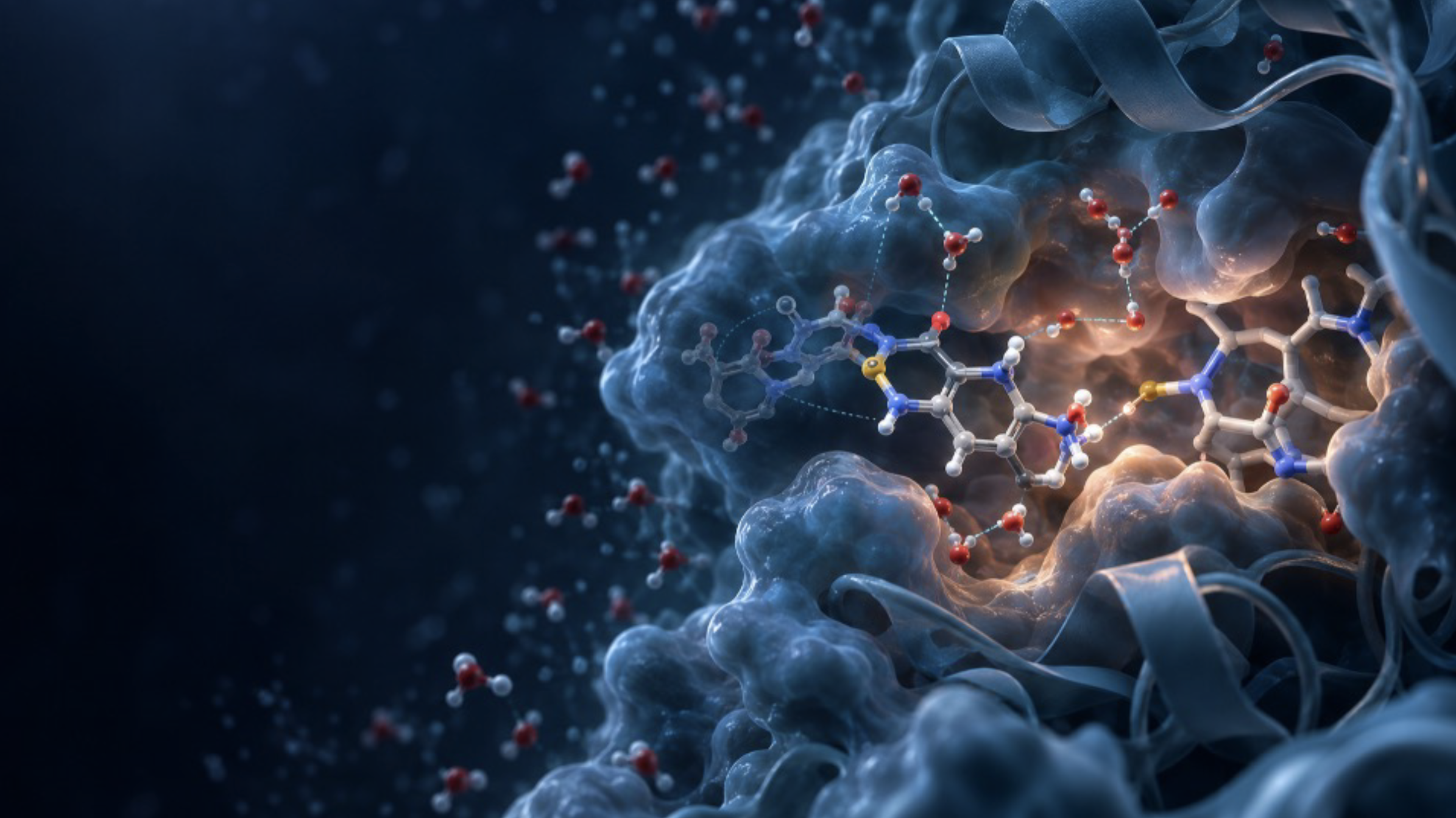
CDCpds are target-templated, single small molecules designed for complex molecular states. The design process represents the relevant target-field topology and engineers a complementary molecular-field topology into the molecular architecture that is then synthesized.
A CDCpd carries an adaptive ensemble — accessible, interconverting states — within one molecule. At the target, recognition forces are intended to favor the state that can perform the needed chemical job.
This differs from creating a physical dynamic library and selecting a binder from it. ReMatrix specifies one adaptive molecule before synthesis, integrating recognition, reaction chemistry, native-matrix sparing, and liability constraints in the design process. It’s a computational approach and the value must be established experimentally; the intended product is a conventional, synthesizable small molecule.
The ReMatrix Application
For mature glucosepane, the intended sequence is recognition, water/proton pre-organization, unmasking of the closed ring, and cleavage or unlinking of the covalent bridge. The exact chemical route, intermediate, and product identities are empirical questions.
The planned assays will use authentic mature glucosepane and matched native-matrix controls. The proof standard is identified unlinking products with mass balance and an intact protein backbone and native enzymatic crosslinks—not merely loss of starting material.
The base program develops one CDCpd. If results show the functions should be divided, a staged CDCpd Swarm™ can introduce coordinated, role-specialized molecules in one dosage form; each member must pass defined evidence gates.
QAINET® and the In Silico Platform
QAINET® is the founder-built, constraint-based AI Horizon system that drives and manages the proprietary In Silico Platform. It evaluates candidate, target, water, native-matrix, and liability contexts as interacting systems across adaptive states.
For the AGE program, this process performs candidate selection and comparative characterization before synthesis. The selected computational lead passed both separation gates in all three computational profiles; this is a prediction awaiting physical confirmation. Synthesis and assay results will determine whether it advances, is redesigned, or is replaced.
The pre-IND Asset Package IP for the AGE program is assigned to ReMatrix Bio. The underlying In Silico Platform implementation remains separate proprietary platform technology.
A 2001 Drug-Discovery Track Record
In 2001, an earlier version of the platform designed a separate AGE-cleaving compound for a biopharmaceutical partner. With the published reaction route disabled, the partner synthesized it, confirmed in vitro AGE activity in its primary assay, and subsequently obtained patent protection covering one or more compounds from that program.
The historic compound addressed an accessible AGE model. Mature glucosepane has closed, ring-masked chemistry and requires an additional unmasking step. The 2001 result demonstrates relevant platform lineage and team experience—not experimental evidence for ReMatrix Bio’s current glucosepane candidate.